Prevent plastic waste in our seas: Audi Foundation cooperates with CLEAR RIVERS
11/25/2021 — Reading Time: 2 min

Together against plastic waste: Opening of another Litter Trap in the Danube in Budapest
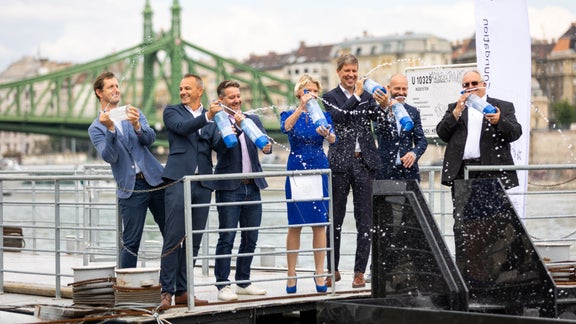
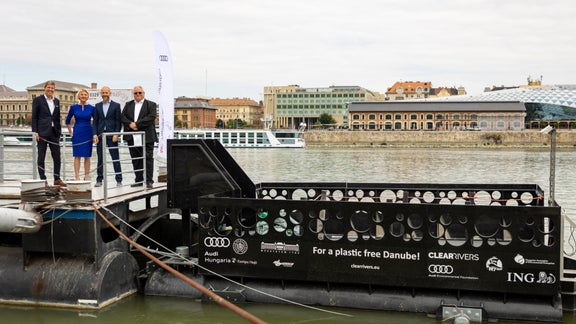
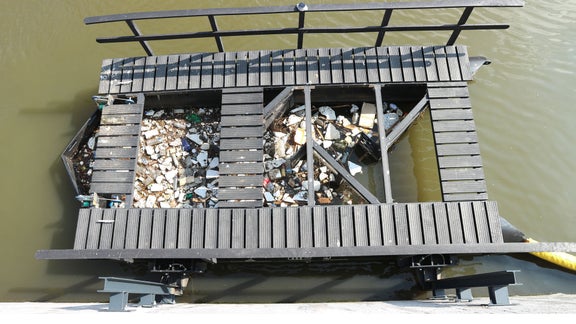
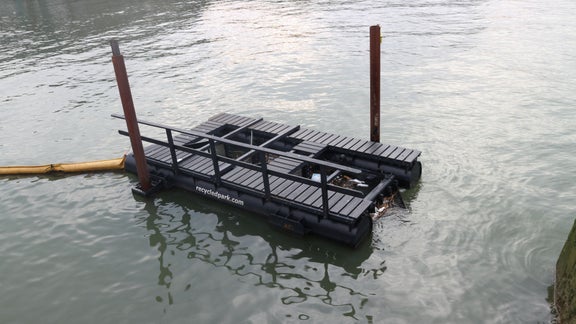
As part of the cooperation between the Audi Environmental Foundation and CLEAR RIVERS another location was chosen for the installation of a Litter Trap: In Budapest, a floating Litter Trap was opened in the Danube river near the Faculty of Technology and Economics of the University of Budapest.
After the Litter Traps in the Charleroi Canal in Brussels and in Rotterdam, the newly installed Litter Trap is the third collaboration with the non-profit organization CLEAR RIVERS. It aims to collect carelessly discarded waste and thus prevent it from entering the open sea. The retention devices of the Litter Trap are characterized by an intelligent conception that is passively integrated into the flowing water eliminating the garbage without conventional nets and vacuum cleaner systems. This way fish and other aquatic animals can be protected.
The collected plastic waste from the Danube is regularly sorted and recycled in a closed loop by also processing it into new products. The Audi Environmental Foundation has set up several seating elements that are made of this recycled plastic as illustrative objects at Audi production sites. These benches are intended to draw attention to the global problem of plastic pollution in water bodies.
"More than 90 percent of the plastic in oceans is transported there via rivers. The avoidance of plastic waste in the environment therefore is one of the central goals of our foundation's work. " explains Rüdiger Recknagel, Spokesman of the management of the Audi Environmental Foundation.
In addition to the Litter Trap CLEAR RIVERS also wants to raise awareness for the environmental damage caused by plastic waste with team campaigns and educational programs.
Litter Trap in the Port of Brussels
Together with Audi Brussels and the Port of Brussels, in March 2019 the Audi Environmental Foundation and its project partner CLEAR RIVERS installed a litter trap in the harbor basin of Brussels.
One cubic meter of plastic waste per month
The litter trap is a specially developed collecting basin, where the floating waste is flushed into a net, and retention devices prevent it from being washed out. With this procedure, it can be ensured that the amount of plastic reaching the ocean via the canal is reduced. The litter trap was installed in the harbor basin and is emptied twice a week. The average amount of waste collected is one cubic meter per month.

Recovered waste serves an innovative purpose
The pollution of our oceans with plastic waste is a global problem. The Audi Environmental Foundation aims at solving this problem together with CLEAR RIVERS. Collecting basins are designed to reduce the amount of floating waste entering downstream waterways.
More than 98 percent of the waste floating in the rivers is located in the first meter below the surface and most of it is actually flowing only 50 cm below the surface. This makes it possible to collect the waste in nets. With catch basins, preventing the debris from being washed back out by strong waves. The waste is not only collected and recycled but it is also used for an innovative new purpose.
With a variety of techniques, such as pressing, welding and 3D printing, our project partner produces hexagonal plastic islands, which can be connected and used as a floating park.
The project is intended to create additional habitat structures for fish and other aquatic species.

Recycled Park Rotterdam – a pilot project
The first floating park made from plastic waste was opened in July 2018 at the harbor basin in Rotterdam by Rüdiger Recknagel, Managing Director of the Audi Environmental Foundation, and Ramon Knoester, founder of the Recycled Island Foundation.

A plastic island as breeding ground for plants and trees
The plastic island landscape in Rotterdam has a total area of 140 square metres. In the installation, plastic islands of 5 square meters each would be connected and planted. It is also possible to plant moss and trees several meters high. Most blocks have an open structure through which the roots of the plants grow. This creates a thicket of roots below the water surface. Algae and other water plants can thrive ideally in these spaces.