Digitized Beehive Münchsmünster
Just in time for World Bee Day on 20 May, a bee colony is moving into the digitized beehive in Münchsmünster
05/20/2020 — Reading Time: 2 min
As pollinators, bees (honeybees and wild bees) play a fundamentally important role in preserving biodiversity and ensuring the security of food supply. To emphasize the importance of this trait, World Bee Day was created. World Bee Day takes place on May 20 and goes back to the Slovenian master court of Maria Theresa in Vienna, Anton Janscha.
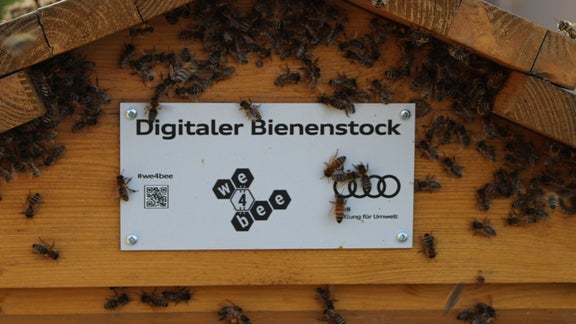
Since its founding more than 15 years ago, the Audi Environmental Foundation has supported projects concerned with bee research and beekeeping education, including the sensor-based we4bee project described here. It supports projects at schools that are intended to reduce the inhibition threshold for beekeeping. Distributing beehives and beekeeping equipment is intended to get students excited about the small and important insect. In addition, the Audi Environmental Foundation combines its environmental education and specific environmental activities with research into technology-based applications for selected environmental topics under the heading ‘Greenovation’. This is also the case in the we4bee project, in which a beehive equipped with various sensors was developed last year. More than 100 specimens of these beehives have since been built and distributed to participating schools and educational institutions. The beehives are digitally networked with each other. All data is collected centrally on the server of the University of Würzburg, where it is scientifically analyzed by data science specialists using machine learning. The aim is to gain a detailed understanding of the bee behavior and health status of the respective bee colonies by evaluating this sensor data. The project investigates whether sensor data can provide indications that may support beekeepers in selecting care measures and intervention times The sensor data are being investigated for correlations between environmental factors, such as weather or traffic, and measured changes in colony behaviour and development. One research question is whether patterns in bee-colony sensor data correlate sufficiently with environmental conditions to investigate their potential as indicators of weather events. The project has not established predictive capability at this stage.
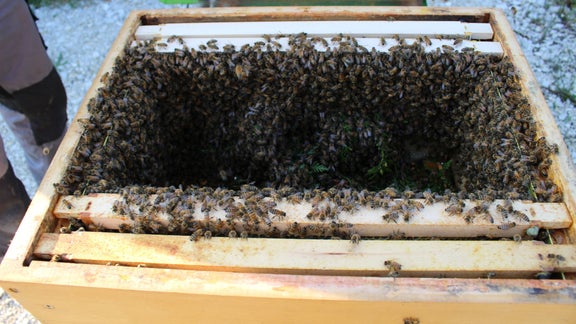
While last year the hardware was developed, tested, produced and distributed, "now the place comes to life". In times of Corona-related shutdowns with school closures, there will be delays in many places. We are even more pleased that the beehive of the Audi Environmental Foundation was able to be stocked with a swarm of bees last weekend – i.e. just in time for World Bee Day 2020 – in compliance with hygiene regulations. The bees have quickly settled into their new home, as the measurement data impressively show. The scale of the digital hive showed a "feed weight" of 3.3 kg. After just one day, the weight has already risen to 4.4 kg. These measurement data impressively show how diligently the bees collect pollen and nectar, as well as how they have begun to build honeycombs and lay eggs. Let's stay curious about how the bee colony develops and what exciting insights and insights we will gain from the sensors.
Audi Environmental Foundation – Home of Greenovation!

Beekeeper "knocking in" a swarm of bees